- About Us
- Contact Us
- English


Triethanolamine (TEA) 85% – Specifications, Uses & Bulk Supply
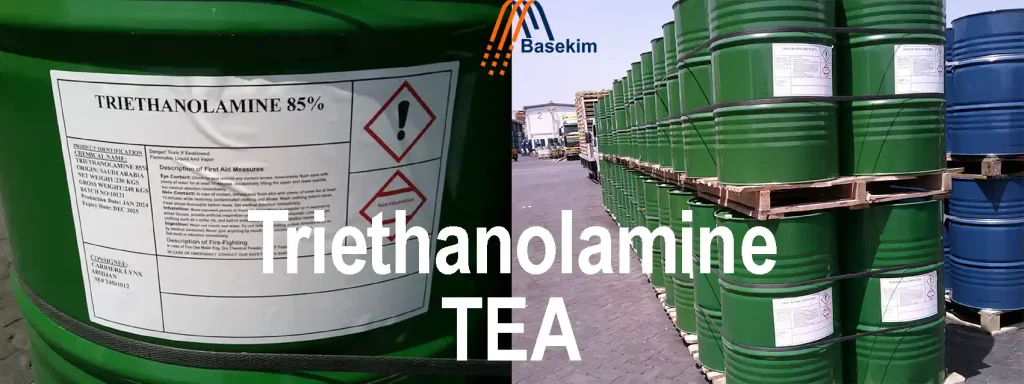
Triethanolamine 85%, commonly known as TEA 85, is a versatile ethanolamine used across industrial, chemical, construction, detergent, textile, coating, and personal care applications. Manufacturers value this material because it combines alkaline properties, water solubility, emulsification performance, and pH control in one product.
Triethanolamine belongs to the ethanolamine family together with other industrial ethanolamine products. Basekim supplies ethanolamine-based chemicals for various industrial applications and international bulk requirements. TEA has the chemical formula C₆H₁₅NO₃, CAS Number 102-71-6, and a molecular weight of approximately 149.19 g/mol.
Industries use Triethanolamine 85% to adjust pH, neutralize acidic compounds, improve formulation stability, support cement grinding, enhance cleaning formulations, and assist in metalworking and coating systems. Therefore, choosing the correct TEA grade and specification plays an important role in product performance.
Triethanolamine 85% Specifications
Buyers should review the technical specification before ordering TEA because purity, water content, density, color, and related components may influence the final application.
| Parameter | Typical Specification |
|---|---|
| Product Name | Triethanolamine 85% |
| Abbreviation | TEA 85 |
| CAS Number | 102-71-6 |
| EC Number | 203-049-8 |
| Chemical Formula | C₆H₁₅NO₃ |
| Molecular Weight | 149.19 g/mol |
| Appearance | Clear to pale yellow viscous liquid |
| Triethanolamine Content | Approx. 85% |
| Physical Form | Viscous Liquid |
| Solubility in Water | Miscible |
| Odor | Mild / Characteristic |
| Chemical Family | Ethanolamines |
| Main Function | pH Control, Neutralization, Emulsification |
| Grade | Industrial / Commercial Grade |
| Storage | Cool, dry and ventilated area |
Exact specifications can vary according to production source and grade. Buyers should therefore confirm the latest TDS and SDS before placing bulk orders.
Triethanolamine 85% vs Triethanolamine 99%
One of the most important purchasing decisions involves selecting between Triethanolamine 85% and Triethanolamine 99%.
TEA 85 contains a lower concentration of triethanolamine and generally contains a higher proportion of water compared with TEA 99. This difference can affect viscosity, handling, formulation concentration, cost, and the required dosage in industrial processes.
Triethanolamine 85% often works well in applications where extremely high purity is not required. These applications may include cement additives, industrial cleaners, detergents, metalworking formulations, coatings, and several chemical processing systems.
In contrast, Triethanolamine 99% provides a higher active concentration and may be selected for formulations that require tighter purity specifications.
Buyers should not select a grade only according to price. Instead, they should consider the required active concentration, production process, formulation compatibility, and technical specifications. Additional technical product information can also help buyers compare industrial requirements before selecting a suitable grade.
Triethanolamine Uses
Triethanolamine offers several functions across different industries. Depending on the formulation, TEA can act as a neutralizing agent, pH regulator, emulsifier, alkalinity source, corrosion control component, or processing aid.
Cement and Concrete Applications
The cement industry represents an important industrial market for triethanolamine.
Manufacturers can use TEA in cement grinding aids and concrete admixture formulations. In grinding systems, properly formulated ethanolamine additives can help improve the efficiency of cement processing and support desired performance characteristics.
However, manufacturers must carefully control dosage. Excessive use can alter cement behavior rather than improve it.
For this reason, producers normally determine the correct TEA concentration through formulation testing and production trials.
Detergents and Industrial Cleaning
Triethanolamine also appears in detergent and industrial cleaning formulations.
Its alkaline nature helps formulators control pH and neutralize acidic ingredients. Moreover, TEA can support surfactant systems and improve formulation stability.
Manufacturers may use TEA 85% in industrial cleaners, household cleaning formulations, degreasers, and specialty detergent systems, depending on the required formulation.
Because different cleaning products operate at different pH levels, formulators should always test the final product rather than relying on a fixed TEA dosage.
Metalworking Fluids
Metalworking fluid manufacturers use ethanolamines in selected cutting fluids, machining fluids, grinding fluids, and corrosion-control systems.
Triethanolamine can help maintain alkalinity and support stable fluid formulations. It may also contribute to corrosion management when used as part of a properly designed additive package.
The final performance, however, depends on the complete formulation, including surfactants, corrosion inhibitors, lubricants, water quality, and other additives.
Glue and Adhesive Applications
Triethanolamine can also support selected glue and adhesive formulations, particularly where manufacturers need pH adjustment, neutralization, dispersion control, or formulation stability.
Its chemical structure allows TEA to interact with acidic ingredients and other formulation components. Therefore, manufacturers may use it as part of adhesive systems designed for construction, industrial bonding, coatings, packaging, and other applications.
The appropriate concentration depends on the adhesive chemistry and required final properties. Manufacturers working with these systems can also review information about industrial adhesive materials when evaluating compatible raw materials.
Paints and Coatings
Triethanolamine can play a role in certain paint, coating, adhesive, and resin formulations.
Formulators mainly use it for neutralization, pH control, dispersion support, and interaction with acidic components.
Maintaining the correct pH can significantly influence coating stability, viscosity, storage behavior, and application performance. Therefore, manufacturers should carefully control TEA dosage during production.
Textile Processing
Textile manufacturers may use triethanolamine in selected processing chemicals and treatment formulations.
Depending on the process, TEA can support pH adjustment and chemical stability. It may also appear in specialty textile auxiliaries.
Because textile processing involves different fibers, dyes, chemicals, and production conditions, the required TEA grade and dosage can vary considerably.
Gas Treatment and Chemical Processing
Ethanolamines have long been associated with gas treatment and chemical processing systems.
Triethanolamine may be used in selected applications involving neutralization and chemical absorption. However, modern gas treatment systems use several different amines, and the correct choice depends heavily on process conditions.
Therefore, buyers should select the ethanolamine based on technical requirements rather than treating TEA, MEA, and DEA as interchangeable products.
Triethanolamine in Cosmetics and Personal Care Products
Triethanolamine also appears in some cosmetic and personal care formulations.
Manufacturers may use TEA as a pH adjuster and neutralizing ingredient in creams, lotions, gels, cleansing products, and other formulations.
For example, TEA can neutralize certain acidic ingredients and help create a suitable consistency in specific cosmetic systems.
However, cosmetic formulators must follow applicable regulations and carefully control ingredient compatibility. Triethanolamine should not be described as universally safe under all conditions simply because it is widely used.
Manufacturers must control concentration, product purity, contamination risks, and formulation conditions according to the intended market.
Triethanolamine 85% vs MEA and DEA
Triethanolamine belongs to the ethanolamine family together with Monoethanolamine (MEA) and Diethanolamine (DEA).
Although these products share several chemical characteristics, they do not provide identical performance.
MEA generally offers stronger alkalinity and a lower molecular weight. Therefore, industries often use it when stronger neutralization or gas treatment performance is required.
DEA contains two hydroxyethyl groups and provides different solubility, viscosity, and formulation characteristics.
TEA contains three hydroxyethyl groups, giving it a different balance of alkalinity, viscosity, and formulation behavior.
Therefore, manufacturers should select between MEA, DEA, and TEA according to the final application, desired pH, formulation system, processing temperature, and required purity.
Triethanolamine 85% Packaging
Bulk buyers should confirm packaging before shipment because packaging options can vary according to the destination country, order volume, and transportation method.
Commercial TEA products may be supplied in industrial drums, intermediate bulk containers, or other suitable bulk packaging systems.
Before ordering, buyers should confirm:
Net weight
Packaging material
Pallet configuration
Container loading quantity
Country of origin
Label requirements
Export documents
SDS and TDS availability
Correct packaging reduces contamination risk and supports safer storage and transportation.
Triethanolamine Price
Triethanolamine 85% price changes according to several commercial and market factors.
The most important factors include:
TEA purity
Order quantity
Packaging
Country of origin
Raw material costs
Freight rates
Destination port
Incoterms
Market availability
Currency fluctuations
Therefore, buyers should avoid relying on outdated fixed prices when planning a bulk order.
For an accurate quotation, purchasers should provide the required quantity, destination, packaging preference, and requested delivery terms.
Buying Triethanolamine 85% in Bulk
Companies that consume TEA in large volumes should work with a source that can provide consistent specifications, export documentation, suitable packaging, and reliable shipping arrangements.
Before confirming a bulk order, buyers should request the latest technical data, safety data, packaging information, origin details, and commercial quotation.
International buyers should also confirm Incoterms, destination port, required documentation, loading quantity, and estimated shipment conditions before placing an order.
Storage and Handling
Store Triethanolamine 85% in a cool, dry and well-ventilated area using suitable chemical containers.
Keep packaging tightly closed when the product is not in use. In addition, protect the material from contamination and incompatible substances.
Workers handling TEA should follow the latest Safety Data Sheet and use suitable personal protective equipment according to workplace conditions.
Eye contact should be avoided because triethanolamine solutions can cause irritation. Workers should also prevent unnecessary skin exposure and follow standard industrial hygiene practices.
Companies should train employees according to local occupational safety regulations before handling bulk chemicals.
TEA 85 SDS and TDS
Professional buyers should always review the latest Triethanolamine 85% SDS and TDS before using the product.
The Technical Data Sheet (TDS) normally provides information about:
Purity
Appearance
Density
Water content
Chemical properties
Product specification
The Safety Data Sheet (SDS) provides information about:
Hazard identification
Safe handling
Storage
First aid
Personal protection
Spill management
Transport
Disposal
A TEA 85 product page should always link to documentation that specifically matches the 85% grade. Technical data for TEA 99% should not be presented as the specification for TEA 85%.
1.What is Triethanolamine 85%?
Triethanolamine 85% is a commercial ethanolamine grade containing approximately 85% triethanolamine. Industries use it for pH control, neutralization, cement additives, detergents, metalworking fluids, coatings, adhesives, and other chemical formulations.
2.What is the CAS number of Triethanolamine?
The CAS Number of Triethanolamine is 102-71-6.
3.What is the chemical formula of Triethanolamine?
The chemical formula of Triethanolamine is C₆H₁₅NO₃.
4.What is the difference between TEA 85 and TEA 99?
The main difference is active triethanolamine concentration. TEA 99 provides a higher concentration, while TEA 85 contains more water and may suit industrial applications where very high purity is not necessary.
5.Is Triethanolamine soluble in water?
Yes. Triethanolamine is highly miscible with water, which makes it useful in many water-based industrial formulations.
Related Products
Share On

Contact Info
Ankara Office
No.6, Fahrettin Pasa St. (613), Ilkbahar, Cankaya – Ankara
Tel: +90 312 514 70 55
Istanbul Office
No. 219, Sogut St., No.20, T4A Block, Maslak, Sariyer – Istanbul
Tel: +90 212 807 22 33
Dubai Office
No.3509, The Burlington Tower, Business Bay, Dubai – UAE
Tel: +971 4 236 98 30